
The same agents through the life of a game
This post explains how agents that play your game like people can help design and QA from first ideas through the years after launch, and how those same agents can later become language modes, AI players in matchmaking, and a simpler way for more people to play a hard game.
Studios tend to buy AI one stage at a time.
One tool helps during early design. Another runs scripted QA checks. A third analyzes data after launch. If the studio later wants AI opponents or language controls for players, that becomes another project.
The game moves forward, but the AI starts over.
A better setup begins with agents designed with the studio for the specific game. They play the real game, make legal moves in its engine, and play in varied ways. Those agents stay with the game from the first playable through production, launch, and live ops. They change as the game changes.
Later, the same agents can work with players by taking orders in language, joining matchmaking, or making a language-only phone mode possible.
Playthrough and Playthrough Console are the design and QA half of this system. Playable is the player-facing half. They are two uses of the same agents across the life of a game.
Start with the first playable
The first playable is where a design begins producing evidence.
Before that point, a team can discuss rules, model outcomes, and predict how systems will interact. Once there is a real game to play, the important questions become concrete. What happens when different systems meet? Which strategies emerge? Where does play become repetitive, weak, or surprising?
Internal playtests begin answering those questions, but five people in a room will not cover a game with many interacting systems. People also tend to play the intended way. They know what the feature is supposed to do, so they often begin with the path the team expects.
The interesting cases may come from combinations nobody wrote in advance, such as two items, a map, and a disconnect. Agents add more play before there is a large player population. Because they take legal actions in the real engine, the resulting matches are not hypothetical examples. They are games the build actually allowed.
The agents are designed with the studio for that particular game. They are not generic bots laid on top of it, and they are not fixed scripts that repeat the same route. They can begin differently, make different choices, miss opportunities, and run into combinations nobody selected in advance.
This distinction matters. A chat demo that looks smart is easy to confuse with a build that lets the agent take the move. The agent has to act inside the real game before its play can give the team evidence about the design.
That gives designers a broader set of real matches to examine while the game is still taking shape.
Keep the agents through production
As production continues, design and QA ask different questions about the same build.
QA needs to know whether the game works. Design needs to know what a change does to play. A scripted check can tell you the shop takes money and the player's game stays in agreement with the server. It cannot tell you whether a new unit changed how people should play, or whether that change is one you want.
Agents playing complete matches create evidence for both jobs. A failure can be investigated in the match where it occurred. A balance claim can be checked against the games behind it.
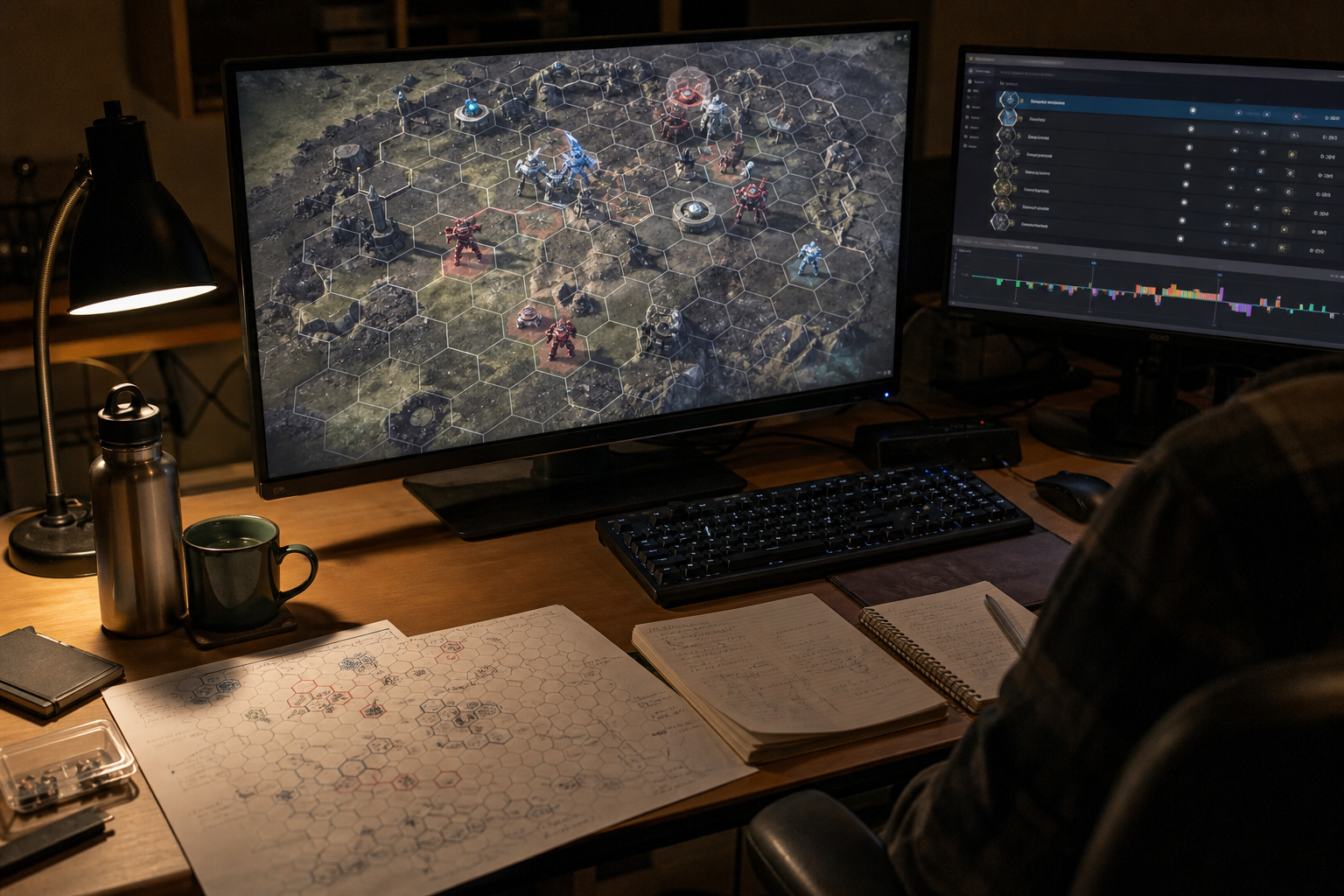
Playthrough Console is where the team works with those matches. Someone can ask questions such as:
- What are people likely to do with this new unit?
- Did this change actually move the fight?
- Where did last night's patch break?
- Is this item showing up in winning games more than it should?
The console can pull the relevant games, examine the set, and mark what stands out. If a number looks sure, open the games behind it. The number is not the conclusion. The matches show what actually happened.
The working loop is simple:
- Ask a question about the current build.
- Pull the relevant matches.
- Open the games behind the result.
- Decide what needs human attention.
Human play still matters. Designers judge whether play is satisfying and whether an observed pattern belongs in the game. QA spends time on failures that already showed up instead of relying only on known test paths. The agents do not replace those decisions. They help the team reach them with more real play in front of them.
Adapt them as the game changes
Agents that stay with a game cannot remain frozen.
A game changes throughout production. It gains content, loses systems, develops new strategies, and attracts ways of playing that were not present in the first playable. An agent that represented the game months ago may not represent it well now.
The agents need to change with the game. They need to learn the new content and patterns so they can keep producing useful matches.
The advantage is continuity. The studio does not replace an early design tool with a QA bot and then replace that bot with a post-launch product. It updates agents that already play the real game and uses them to answer the questions that matter at the current stage.
Early in development, the team can ask what a system makes possible. During production, it can ask what changed and where the build broke. Before launch, it can check whether a claim holds up across actual matches. During live ops, it can ask what a patch did and what should happen next.
The questions evolve, but the method stays the same. The agents play the current game, the team examines the resulting matches, and people open the evidence behind a claim.
Use them before and after every patch
After launch, the job stays familiar, but the clock gets worse.
A live team can have clips, charts, and forum posts within hours of a patch. Live data can tell you something moved, but it does not give you the match. Those signals matter, but they may not explain what happened or show the sequence that produced the result.
The team also cannot wait a week for players to teach it what the patch did.
Agents that already know the game can play the new rules before a patch becomes public and again the morning it goes live. That gives the team matches on both sides of the release.
In Playthrough Console, the team can ask whether the change produced the intended effect, pull the relevant matches, and open the games behind an apparent result. Community reactions and dashboards still matter, but the team also has play it can inspect.
After launch, the decisions are often whether to take the change back, ship a fast fix, or wait. That decision still belongs to the studio. The agents provide matches that help the team make it without relying only on a number, clip, or reaction it cannot trace.
This is why keeping the same agents matters. If a studio waits until live ops to introduce an isolated analysis tool, that tool must begin learning the game when time is shortest. Agents that have stayed with the game since the first playable reach launch as part of an established way of working.
Put the same agents with players
Once agents can play the real game, their role does not have to remain behind the scenes.
The same agents can sit in matchmaking as AI players. They can also take a player's language orders and carry them out as legal moves. The player says what they want to do, and the agent acts inside the game's rules.
This makes language another way to control the game. It is not a separate chat demonstration that is disconnected from play.
The same approach can support a language-only phone mode for a game that has historically worked on a computer or console. A player can do repetitive parts, follow current strategies, or play a lighter mode by speaking or typing. They can return to the full controls when they want them.
Arena Tactics reached a polished language-control experience in about four weeks. Language stood in for the parts of its on-screen interface that did not fit a phone.
This is the player-facing half of the system, which we call Playable. The distinction is about who uses the agents, not whether the agents understand a different game. With Playthrough, the agents produce play that helps the studio design, test, balance, and operate the game. With Playable, those agents participate alongside players or act on their instructions.
That later use is possible because the foundation already exists. The agents were designed for the specific game and can take legal actions in its real engine.
One system, two uses
The cheapest place to begin is the game you already have, not a new mode.
A studio can start with its immediate need for more real play in design and QA. It can build agents with the team, run them in the real game, and make their matches available through Playthrough Console. The team can use that loop on the next design question, balance change, and patch.
Then it can keep adapting the agents as the game moves forward.
When the studio is ready for language orders, AI in matchmaking, or a language-only phone mode, it is not beginning a separate AI project from nothing. It is putting agents that already know how to play the game with players.
Playthrough and Playable are the design and QA use and the player-facing use of one system. The same agents can stay with the game from its first playable through production, launch, live ops, and patch morning.