
Exploring language control and co-play in Total War
A design exploration of how language could open Total War's campaign and battle controls without lowering its strategic bar, then support policies, standing orders, doctrines, command capacity, and counterplay.
Exploring language control and co-play in Total War
A Total War campaign and a Total War battle ask for different kinds of attention, often in the same session.
On the map, the player balances provinces, recruitment, diplomacy, movement, and risk across turns. In the field, the same player has seconds to read terrain, hold a line, time abilities, and answer a flanking move. Late campaign multiplies both jobs: more settlements to shepherd, more heroes to place, more armies that still need a plan when the player is looking elsewhere.
That is why we keep returning to this series when we talk about intent-based control. The interesting problem is not that Total War needs to become easier. It is that good decisions already exist in the player's head while the interface keeps asking for them one click, one province, and one unit card at a time.
Language can sit beside mouse and keyboard as another way to issue those decisions. A sentence can recruit, set a settlement posture, give a hero a standing brief, or dictate a battle plan. The translation still has to land on legal actions. Costs, movement, visibility, and uncertainty stay in force. Manual override still wins. Language never removes a control.
When that intent can persist as policy rather than as a one-off command, the strategy space changes. Settlements can run under rules the player wrote. Recruitment can target a composition instead of a single unit. Heroes can coordinate without constant babysitting. Battle groups can hold conditional orders. Doctrines can become named objects that cost capacity, create stories from distant fronts, and give opponents something to scout, steal, or break.
This is co-play with Total War's existing systems, not a substitute for attentive play.
Language can open an existing control surface
The narrowest language mechanic maps a sentence to an action the player can already take.
A player says:
Recruit two spearmen in Altdorf.
The game resolves the settlement, checks the available recruitment pool, calculates the cost and duration, and presents or executes the legal order.
No strategic rule has changed. The player still needs to decide whether spearmen are useful, whether Altdorf is the right recruitment location, and whether the treasury can support them. Language is another input method for the same decision.
Even this simple case requires strict grounding. The system must understand references, inspect current game state, distinguish unavailable actions from ambiguous ones, and avoid inventing capabilities. If several settlements or units match a name, it should ask. If an action is costly or irreversible, it should confirm.
This form of control can improve access without changing the strategic bar. A player who can form a good decision but finds the interface difficult can still participate in the real rules of the game.
The larger question begins when the order persists:
What happens when a player can state a policy once and let the game apply it over time?
Persistent intent is more than a different button. It can react to conditions, consume a budget, request approval, and report exceptions. It can also create mistakes and predictable behavior. Those properties make it suitable for strategy.
Settlement policies are a practical starting point
Settlement management is a useful first surface because Total War already contains structured actions, visible constraints, and forms of automation.
Instead of asking the game to make a settlement “better,” a player could define what better means for this province:
Prioritise income, but keep defensive buildings one tier ahead because this is a border province. Keep public order stable. If a hostile army enters the region, pause economic construction, prepare defences, and notify me.
This is not a request for an unconstrained agent to run the campaign. It is a bounded policy over actions that already exist.
The system can compile the instruction into visible rules:
- Prefer income buildings when a slot and budget are available.
- Maintain the specified defensive priority.
- Avoid actions that would violate the public-order constraint.
- Change posture when the stated threat condition becomes true.
- Escalate decisions outside the policy to the player.
The player should be able to inspect, edit, suspend, or delete each rule. Every action should have a reason attached to it. If two instructions conflict, the game should surface the conflict instead of guessing silently.
Settlement policy is also reversible. The player can delegate one province while managing another directly. A direct player order can take precedence over the policy. The system can then ask whether that override is temporary or should revise the standing policy.
This preserves the existing game while adding a new way to manage scale.
Recruitment can express composition, not just unit choice
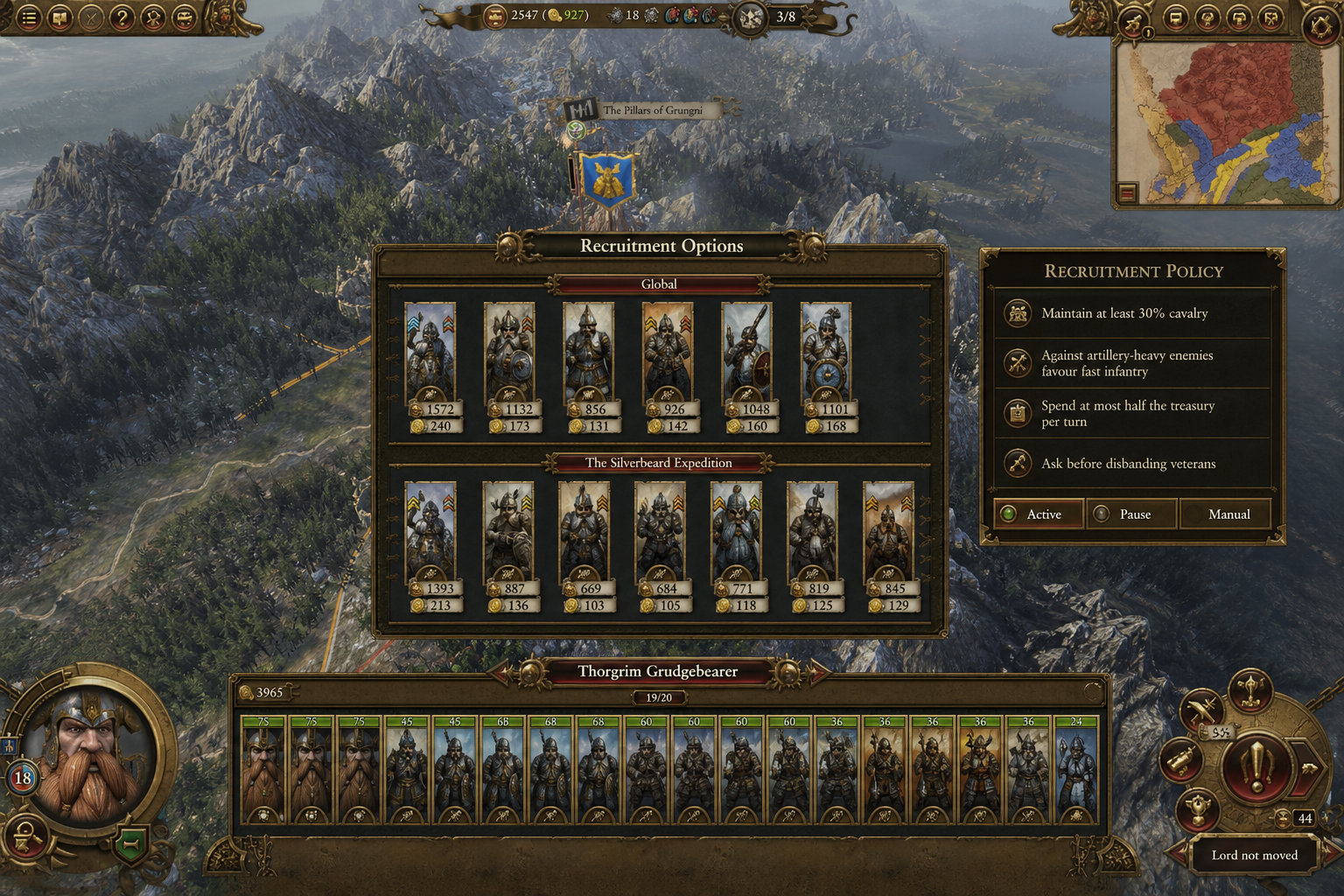
A recruitment policy can hold composition, budget, and approval gates that no slider can express.
Recruitment is usually expressed as a sequence of unit selections. The deeper strategic intent often exists only in the player’s head.
A player may not simply want three cavalry units. They may want an army that preserves mobility, can replace losses, stays within a budget, and adapts to an expected opponent.
A composition policy could express that intent:
Maintain at least four cavalry units and enough anti-large infantry to protect the missile line. Replace casualties before adding new unit types. Against artillery-heavy factions, favour mobile troops. Spend no more than half the current treasury this turn. Ask before disbanding experienced units.
This contains several kinds of constraint:
- A target composition.
- A conditional preference based on the opponent.
- A spending limit.
- An ordering rule for replacements.
- An approval gate for valuable units.
A single recruitment slider cannot hold this decision. A language policy can, but it still needs a formal representation underneath. The player should see how the sentence became constraints and which parts are currently active.
The game must also preserve scarcity. The policy cannot recruit unavailable units, ignore local capacity, bypass global caps, or spend money twice. When the desired composition is impossible, it should report the constraint:
The army cannot reach the cavalry target in this province. Two eligible units are available in the neighbouring region. Moving there would delay replenishment by one turn.
The player remains responsible for the strategic tradeoff. The system makes that tradeoff legible and actionable.
Heroes can operate under standing orders
Campaign agents and heroes often require repeated movement and targeting decisions. That attention can be strategically important, but it can also become mechanical when the player is restating the same intent every turn.
Standing orders could let each hero hold a role:
Shadow the eastern army. Reduce corruption in regions it occupies. Do not attempt offensive actions without confirmation.
Another hero might receive a related instruction:
Maintain order in the capital provinces. Avoid actions with a high risk of removal. If the eastern agent discovers a hostile cult, move to assist when the route is safe.
These are not isolated commands. They form a small coordination system. One standing order can refer to an army, province, threat, or another character.
That makes failure handling important. A hero may be blocked, wounded, redirected by a new threat, or unable to satisfy two instructions at once. The game should not hide these conditions. It should treat them as command exceptions and return them to the player.
A useful report might say:
The eastern army moved beyond the hero’s current range. Following it would leave the capital without coverage for two turns. Which order has priority?
This is co-play in a practical sense. The player defines goals and boundaries. The game executes routine legal actions, reports material changes, and returns uncertain decisions to the player.
Battle dictation can sit inside the real-time loop
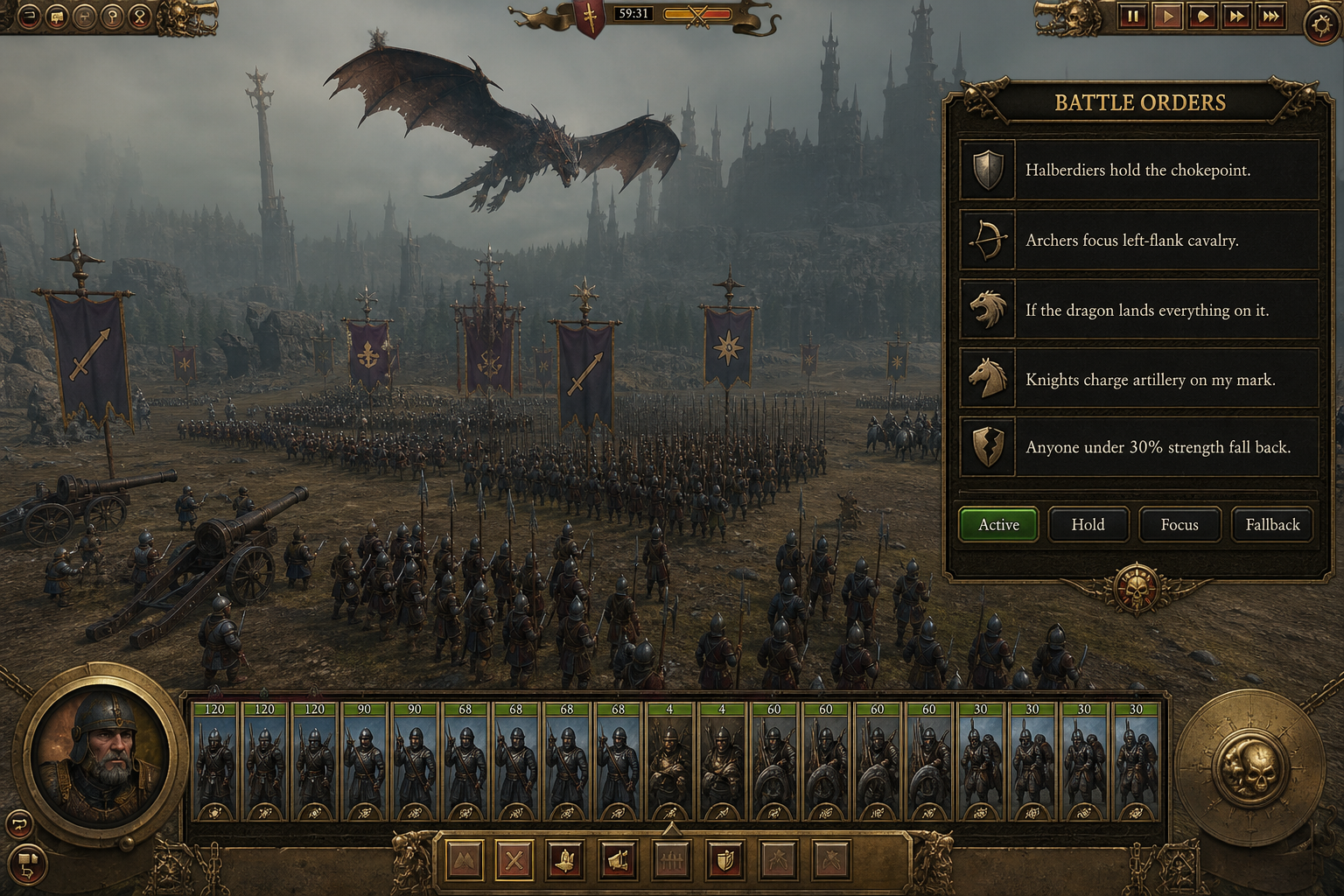
Battle dictation can issue conditional orders while mouse and keyboard stay live.
Real-time battles create a different language-control problem. Campaign policies can wait for confirmation. Battle commands must be understood quickly without pulling the player away from positioning and timing.
A player might dictate:
Halberdiers hold the chokepoint. Archers focus the cavalry on their left. If the dragon lands, switch nearby missile units onto it. Move the knights wide behind the trees and wait for my signal before charging the artillery. Units below one-third strength should fall back.
This instruction combines formation roles, target priorities, conditions, movement, timing, and withdrawal rules.
The system should translate the command into visible orders attached to unit groups. Selection markers, paths, target icons, and conditional indicators can show what it understood. The player can then correct the order by voice, mouse, or keyboard.
Language should not become a source of hidden battle efficiency. It should use the same information available to the player and issue the same legal commands. It should not grant perfect timing, hidden targeting knowledge, or superhuman unit control.
Execution also needs limits. A broad command may take time to propagate, require an eligible commander, or consume a command resource. Units under pressure may interpret it poorly. A broken formation may not execute a complex manoeuvre reliably.
Those limits turn battle dictation into a mechanic rather than an invisible advantage.
Intent needs a visible representation
Natural language is flexible, but games need deterministic state.
A robust system should not leave an active policy as an opaque sentence. It should convert the sentence into a structured and inspectable object.
For example, a recruitment instruction might become:
- Goal: Maintain four cavalry units.
- Priority: Replace losses before expanding composition.
- Opponent condition: Prefer mobile units against artillery-heavy forces.
- Budget: Spend no more than the stated treasury share.
- Approval required: Disbanding experienced units.
- Scope: The selected army.
- Duration: Until revoked.
The original sentence remains useful as context, but the structured policy is what the game executes.
This representation supports correction. A player can change one rule without restating everything. It also supports simulation. Before activating a policy, the game can show likely near-term consequences based on current information.
Intent should be observable in play as well. Settlement panels can show active priorities. Army screens can show composition targets. Hero cards can show standing orders. Battle groups can display pending conditions.
The player should never need to wonder whether an instruction is still active.
The first principle is bounded authority
Language systems become frustrating when they are either too timid to act or too broad to trust. Total War offers a natural middle ground through bounded authority.
Each policy can define:
- Which entities it may control.
- Which actions it may take.
- How much it may spend.
- Which risks it may accept.
- Which conditions cause it to stop.
- Which decisions require approval.
- How long the authority lasts.
A settlement governor might be allowed to reorder construction but not demolish buildings. A recruitment policy might replace losses but require approval before adding a new unit category. A battle group might respond to a flanking threat but remain forbidden from leaving a designated area.
These boundaries should be part of the game state rather than hidden safety logic. Setting the right boundary is itself a strategic decision.
Manual override always wins. When a player directly issues a conflicting order, the game follows it immediately. It can then ask whether the underlying policy should change.
The category opportunity begins after the first policy
A settlement policy is a practical entry point because it can sit beside existing management systems. The larger opportunity appears when games treat intent as a native strategic resource.
At that point, language does not merely reduce repeated input. It supports mechanics that would be cumbersome to express through conventional menus.
Command capacity can make delegation costly
Standing orders should not need to be free.
An empire could have a limited command capacity determined by leaders, institutions, technologies, communications, or campaign conditions. Persistent policies would consume some of that capacity.
A simple settlement priority might be cheap. A coordinated frontier doctrine spanning several armies, agents, and provinces might be expensive. Battle conditions with several branches could require more command attention than a direct movement order.
The player then chooses where to delegate:
- Keep the heartland on stable economic policies.
- Reserve capacity for a complicated invasion.
- Manage a vulnerable army directly.
- Reduce the complexity of an existing doctrine to free capacity elsewhere.
This creates a new strategic axis. The question is not only what the empire should do. It is where the player can afford to establish persistent control.
Command disruption can then matter. Wounded leaders, severed communications, corruption, or hostile action might reduce capacity temporarily. Policies could become delayed, simplified, or suspended rather than receiving arbitrary penalties.
Doctrines can become game objects
A policy can begin as a private instruction and develop into a doctrine.
A doctrine is a named, persistent set of priorities used across multiple forces or territories. Players could refine doctrines over a campaign, assign them to commanders, and adapt them for different opponents.
Examples might include:
- A frontier doctrine that favours defence, local recruitment, and rapid reinforcement.
- An artillery doctrine that protects firing lines and avoids pursuit.
- A raiding doctrine that prioritises mobility, supply disruption, and withdrawal.
- A reserve doctrine that holds fresh units until a defined battle condition occurs.
Doctrines can be shared between armies, but commanders may execute them differently based on traits, experience, or local conditions. A disciplined general might follow a complex doctrine reliably. An impulsive commander might depart from it when an opportunity appears.
This gives characters a relationship with player intent. Their value is not only statistical. It includes how well they understand, preserve, or reinterpret a plan.
Doctrines can invite counterplay
Persistent intent becomes more interesting when opponents can learn and exploit it.
Scouting might reveal that an army consistently protects one flank, withdraws at a certain strength, or commits cavalry only after missile contact. Espionage could expose parts of a settlement or recruitment policy. Capturing an archive, commander, or capital could reveal a named doctrine.
That knowledge supports counterplay:
- Present artillery to trigger a mobility-focused recruitment policy, then field a different threat.
- Feint against a frontier to force economic settlements into defensive construction.
- Draw a reserve force into activating early.
- Disrupt the commander responsible for a coordinated standing order.
- Feed false intelligence into an opponent’s threat model.
The policy system should not make every opponent mechanically predictable. Instead, it can create incomplete and contestable information about how forces are likely to respond.
Players can also revise doctrines to conceal their intentions. A known policy may become bait. An apparently rigid standing order may contain a hidden exception.
Language-authored intent then enters the same strategic cycle as army composition or diplomacy: creation, observation, adaptation, and deception.
Co-play should preserve the attentive player
A language-controlled system should not automatically outperform an attentive player.
Its purpose is to preserve intent across scale and reduce the need to repeat already-made decisions. Direct control should remain more precise, more adaptable, and more responsive to unusual circumstances.
Delegated systems can have meaningful limits:
- They act only on available information.
- They obey explicit budgets and authority.
- They may fail when instructions are ambiguous.
- They escalate situations outside their rules.
- They can react more slowly than direct control.
- They can become predictable.
- They can be disrupted by campaign and battle mechanics.
These limits maintain the value of attention. A player who personally manages a critical province or battle should be able to make finer decisions than a standing policy.
The benefit is not higher win rate. It is wider strategic reach.
A player can continue making meaningful decisions across a large campaign without turning every front into a repeated checklist. The late campaign can contain more strategy because the player has a language for directing scale.
Difficulty can remain in the decision
Total War does not need fewer rules to support more players. It needs more ways for players to express their understanding of those rules.
Language can help a player state a legal command without replacing the knowledge behind it. Persistent intent can carry that decision across turns and battles. Bounded authority can keep delegation understandable. Command capacity can make it costly. Doctrines can make it reusable. Espionage and observation can make it contestable.
The result is not a simpler Total War.
What we want to explore is a Total War where dictating doctrine and commanding the decisive fight can share one campaign, without handing the win condition to the automation.