
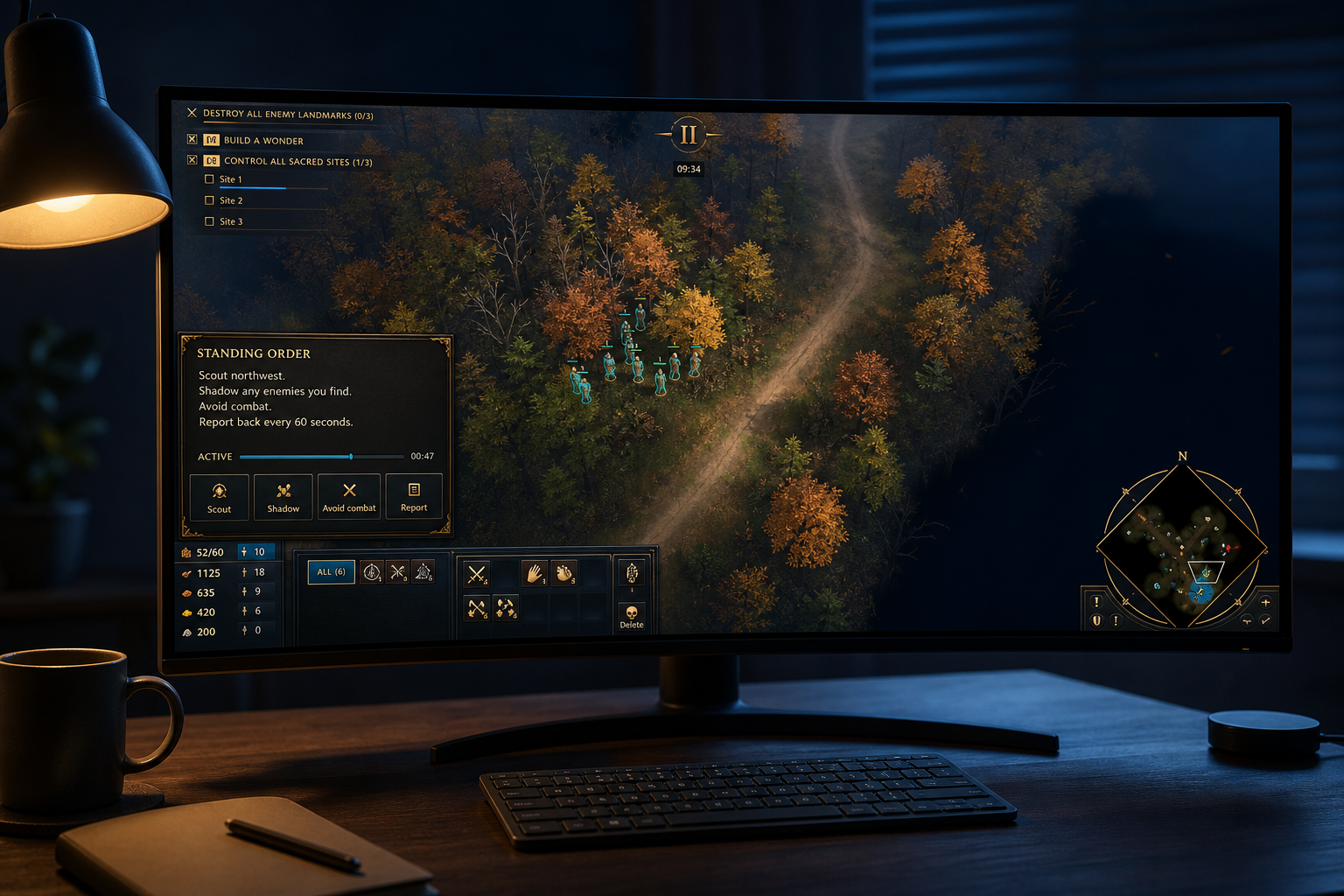
Exploring language control and AI co-play in Age of Empires IV
A design exploration of how language could open the control surface in Age of Empires IV while preserving difficulty and creating new strategy through policies, standing orders, and costed Overseers.
Age of Empires IV is hard for good reasons, and it should stay hard.
A player manages production, economy, scouting, army composition, positioning, timing, technology, and map control at the same time. Civilizations create different constraints and opportunities. A decision in one system changes what is possible in another. Concurrency is part of the strategic test.
It is also a title we keep coming back to when we think about intent-based control.
Language can open the control surface to more people who can form a valid decision but cannot always express it through the existing input grammar. It does not make the underlying rules easier. The player still has to choose the right objective, composition, timing, position, and risk.
The most direct implementation is a language input that converts a spoken or written request into existing commands. That translation is valuable, and doing it reliably is difficult. It can broaden who is able to issue a sophisticated order without changing what counts as a good order.
A larger opportunity appears when intent becomes a first-class part of the game. Players could set policies, issue standing orders, appoint commanders, and pay for delegation. Opponents could identify and disrupt those systems.
The game would remain demanding while gaining a new strategy space.
Language input is not the whole design
Consider a command such as:
Move the spearmen in front of the siege, keep the cavalry hidden north of the crossing, and do not start the fight until the bombards are in range.
A language interface has to turn that sentence into valid game actions. That requires more than speech recognition.
The system must resolve which spearmen, cavalry, siege units, crossing, and bombards the player means. It must understand spatial terms such as “in front of” and “north.” It must preserve the timing condition. It must respond appropriately if terrain blocks the requested formation or an enemy attack makes the plan impossible.
The player also needs to see what the system understood before authority moves too far from direct control. That calls for visible interpretations, bounded permissions, reliable execution, and clear correction paths.
A successful mapping still leaves an important design question:
Why should the command exist as language instead of as another shortcut?
If language reproduces a sequence of clicks, it can open access to an existing decision. That is already meaningful. It lets another player express the same valid plan through a different control surface.
It does not yet create a new kind of strategy. That becomes possible when the intent itself can persist, depend on conditions, consume resources, or become vulnerable to counterplay.
A careful opening surface is limited and reversible
One place to explore language control is the Art of War surface.
A language-aware coach could help players express objectives, identify missing conditions, and understand how a broad request maps to concrete game concepts. The player would still make the decisions and perform the actions.
For example, a player might say:
I keep running out of food when I start producing military units.
The coach could identify relevant questions without taking control:
- Is worker production stopping?
- Are nearby food sources becoming unsafe?
- Is wood arriving too late for farms?
- Is the military production plan consuming more food than the current economy can support?
- Is the civilization’s economic structure being used effectively?
A similar surface in skirmish or unranked play could observe the information available to the player, point out conflicts, and suggest actions. The important constraint is that the coach explains the game rather than deciding what the player should value.
Bounded commands offer another natural step. A player might approve an order that arranges selected units for one engagement. Before execution, the game could show the interpretation through plain language, unit highlighting, and map overlays.
This kind of surface is reversible:
- The player can disable it without changing the underlying game.
- Suggestions have no authority to act.
- Approved orders can be inspected and canceled.
- Commands remain limited to selected units, visible information, and stated conditions.
- The player can return to direct control at any time.
These constraints are not there to remove difficulty. They help preserve a clear relationship between what the player intended and what the game executed.
Language opens decisions without choosing them
Intent-based control should not automate every difficult action.
Many direct actions are strategically meaningful because timing and execution matter. Army composition is a strategic choice. The timing of an attack is a strategic choice. Deciding to contest a river crossing is a strategic choice. Language should not decide any of them for the player.
The useful distinction is between execution that remains part of the decision and execution that restates a decision the player has already made.
Repeatedly adjusting several groups so that they preserve a chosen formation while approaching a crossing may be a candidate for intent-based control. The player has already selected the units, the formation, the terrain, and the conditions for engagement. Language provides another way to express that plan while the rest of the match continues.
That creates a bounded one-shot opportunity:
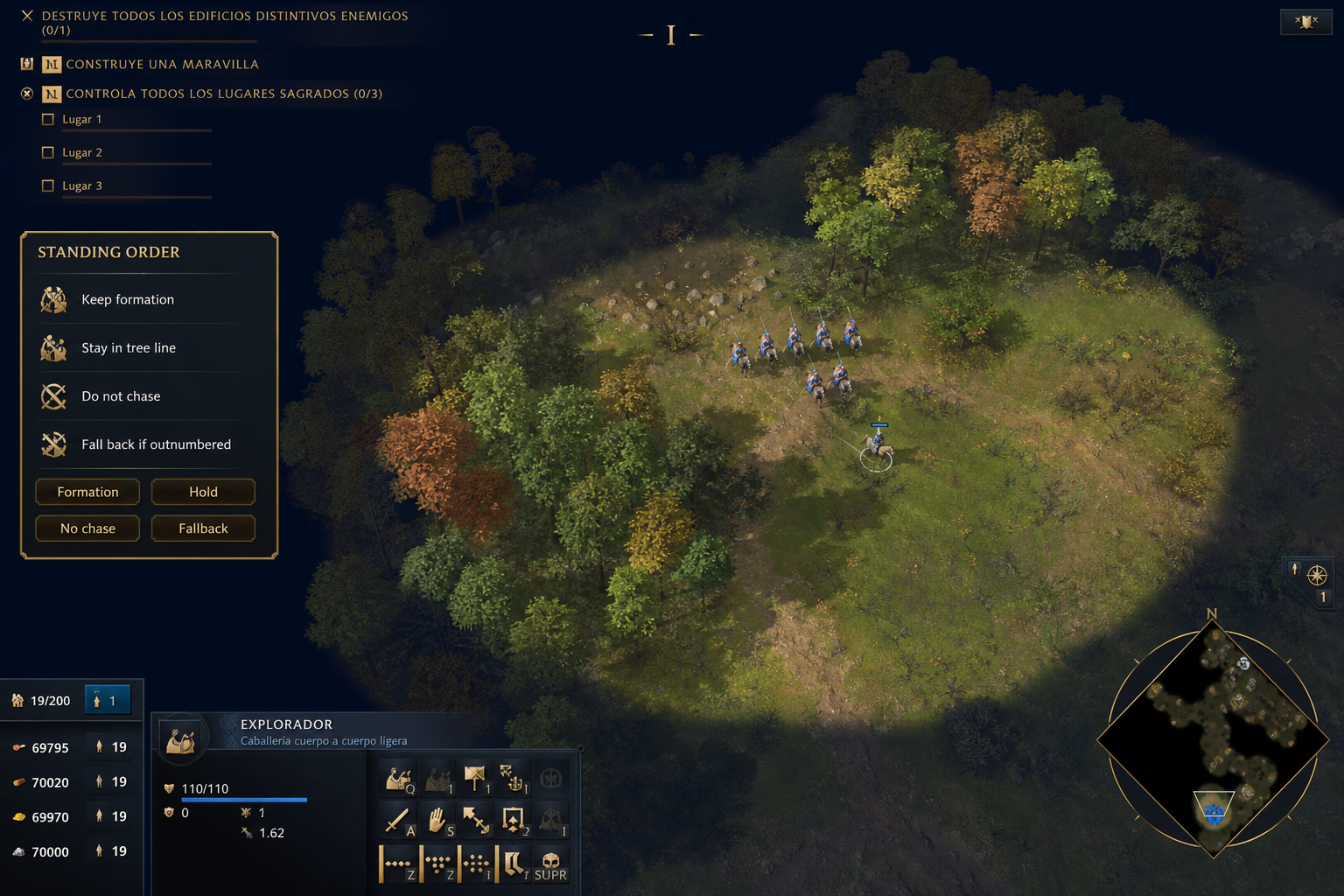
Prepare the eastern crossing for an engagement. Put the spearmen between the enemy approach and the siege. Keep the cavalry out of sight on the north side. Do not chase.
The system could handle local positioning while the player retains control over composition, reinforcements, target selection, and the moment of commitment.
The command does not determine how to win the fight. It expresses a plan the player has already chosen.
Concurrency remains part of the game. The player still has to decide which demands deserve attention, which plans can coexist, and when a delegated order is no longer appropriate.
Policies create a larger strategy space
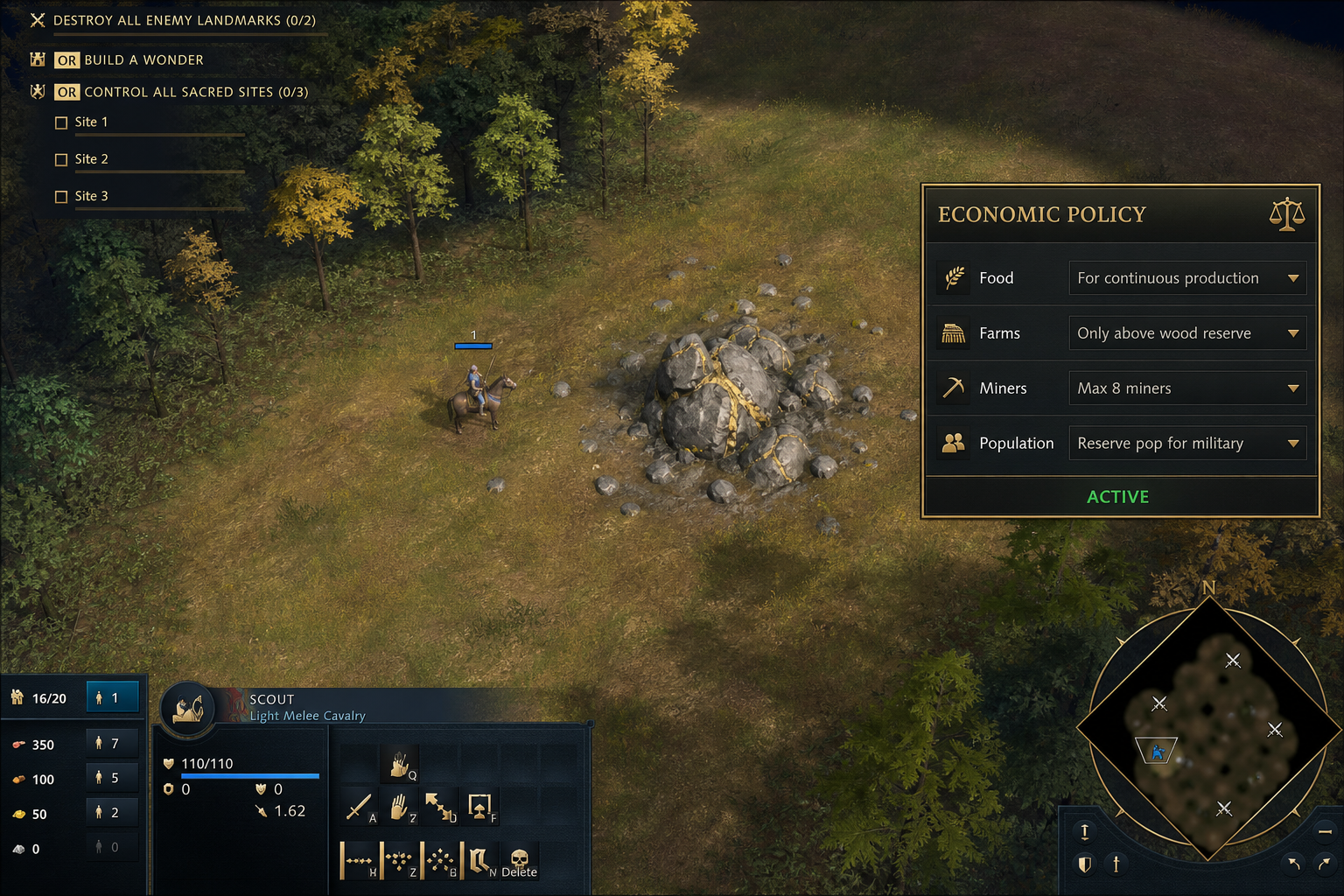
One-shot positioning opens an existing decision through language. Conditional economic policies could go further by making intent an explicit game object.
A player might define a rule such as:
Keep enough workers on food for continuous production. Add farms only when wood is above my defensive threshold. If the nearby gold is exhausted, find another safe source, but keep the miner count below eight. Reserve population space for military units.
This request crosses several systems:
- Food collection and farm construction.
- Wood availability.
- Gold discovery and safety.
- Worker allocation.
- Production requirements.
- Population planning.
Today, the player carries that policy mentally and expresses it through many separate actions. If the game can represent intent directly, the policy can become visible, editable, and contestable.
The interface should not leave it as an opaque sentence. It could compile the request into visible rules:
- Maintain the chosen food production target.
- Do not spend wood on new farms below the defensive reserve.
- Search for a replacement gold source when the current source is nearly exhausted.
- Assign no more than the stated number of miners.
- Preserve the selected amount of population capacity for military production.
The player could reorder rules, suspend them, change thresholds, or take direct control.
The hard part remains choosing a sound policy. A rule that is correct during economic expansion may become dangerous under pressure. A reserve can protect a defensive plan or delay necessary growth. A miner cap can preserve food income or prevent access to an important technology timing.
Civilization asymmetry must also remain intact. A policy should execute through the actual capabilities and constraints of the chosen civilization. It should not flatten different economies into one optimal template. The same stated intent may produce different plans because the available units, technologies, buildings, and bonuses are different.
The policy is therefore more than an automation convenience. It is a strategic commitment whose value depends on the match.
Standing area orders make intent persistent
A second category is the standing area order.
Instead of repeatedly sending units back to the same location, a player could establish an order that remains active:
Watch the western ford for the rest of the match. Report siege units. Do not pursue beyond the tree line. Fall back toward the town if the position is threatened.
This creates a persistent relationship between a force and an area.
The order could have a visible boundary, assigned units, pursuit limits, alert conditions, and a fallback point. The player would be able to inspect exactly what remains delegated.
Standing orders could cover tasks such as:
- Screening a vulnerable trade route.
- Watching a likely crossing.
- Protecting an economic expansion.
- Denying construction within a controlled area.
- Preserving a reserve force instead of allowing it to join nearby fights.
The game would not simply select nearby enemy units and attack them. It would represent a continuing military intent, including the limits that make the order meaningful.
Persistent intent creates strategic failure modes. A force following an old order may be absent from a decisive battle. A cautious pursuit limit may let an enemy escape. An opponent may probe the boundary, learn how the order behaves, and plan around it.
These outcomes follow from the player’s standing decision. They are part of the strategy rather than interface errors.
Stewardry turns delegation into a game resource
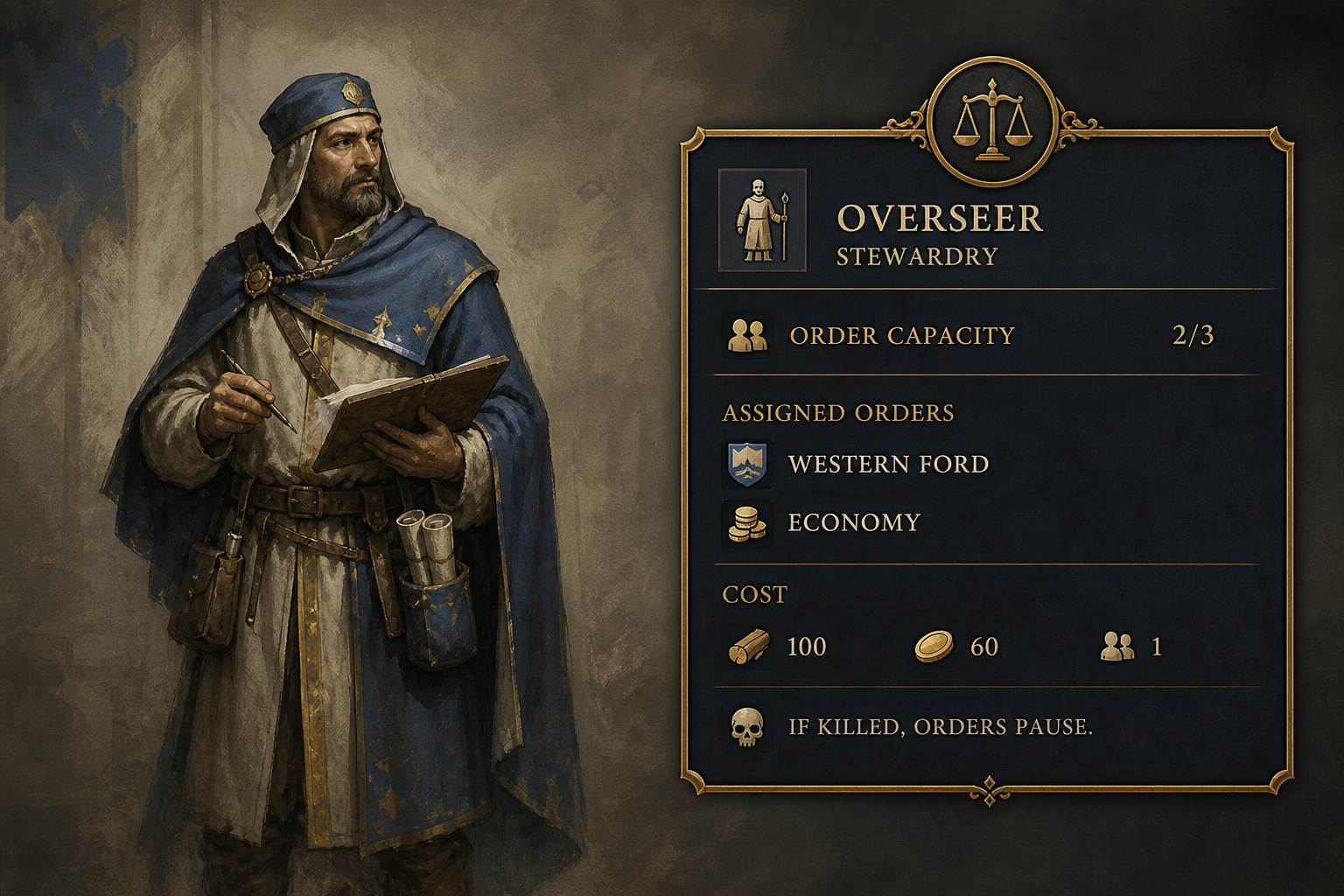
What becomes especially interesting is the possibility of making delegated control a paid and vulnerable part of the game.
Imagine a Stewardry building that trains Overseers. An Overseer can maintain a limited number of policies or standing orders. It costs resources, population, and production time. Assigning one to an army or region gives the player additional coordination capacity, but that capacity has been purchased with resources that could have supported another plan.
This creates a vertical strategic choice.
A player might invest in direct military strength, economic growth, technology, or delegated control. An Overseer would not create units or resources. It would help coordinate existing assets while consuming capacity that could have been used elsewhere.
Delegation could also create direct counterplay.
If an Overseer is killed, its orders could pause, degrade to a simpler behavior, or return to direct player control. If the Stewardry is under siege, the player might lose the ability to create or modify advanced policies. Scouting an opponent’s investment in delegation could reveal both an organizational strength and a vulnerable dependency.
Several variables could shape the balance:
- Overseers can cost resources and population.
- Training and reassignment can take time.
- Each Overseer can have limited order capacity.
- More complex conditions can require more capacity.
- Orders can be restricted by communication range or assigned territory.
- Delegation infrastructure can be scouted and attacked.
- Interrupted orders can demand immediate player attention.
This makes delegated attention an in-game resource rather than an external advantage.
Difficulty remains because the player must decide when coordination is worth buying, what to delegate, how much infrastructure to defend, and when to reclaim direct control. The opponent can attack the delegation strategy itself.
A worked match situation
Consider a player preparing to contest a central crossing while expanding the economy.
The player has chosen the army composition and production plan. Before the engagement, the player issues a one-shot positioning order:
Screen the siege with spearmen at the crossing. Keep the cavalry north and hidden. Do not engage until I give the order.
An Overseer assigned to the army handles that bounded setup.
At home, an economic policy is active:
Maintain food production, keep eight workers on gold, and do not spend the reserved wood unless farms are required.
A standing order protects the western side:
Watch the ford, report siege, and fall back if outnumbered.
These orders do not solve the match. The player still has to interpret scouting information, choose reinforcements, judge the opponent’s composition, and commit at the right moment.
The opponent might attack the western order with a force large enough to trigger its retreat, then shift toward the center. The cavalry’s hiding place might be discovered. The player’s wood reserve may slow farm construction. A raid might kill the economic Overseer and force immediate manual correction.
The resulting contest still depends on judgment. The new mechanics change what players can plan, delegate, conceal, scout, and disrupt.
The goal is a wider control surface and more strategy
Language is useful because it lets players express relationships, conditions, priorities, and exceptions in a natural form.
Its first responsibility is to open the existing control surface without changing the underlying standard for a good decision. Visible interpretations, bounded authority, and reversible commands can help the game preserve that standard.
The larger design opportunity begins when intent becomes part of the rules.
Policies can connect economic systems. Standing orders can persist across a match. Commanders and governors can embody delegated authority. Stewardry infrastructure can make attention a costed resource. Opponents can attack the units and structures that keep delegated plans running.
At that point, language is not only another way to issue existing commands. It supports mechanics that depend on persistent, conditional, and contestable intent.
The opportunity we see keeps Age of Empires IV hard on purpose. Players still choose goals, compositions, timings, investments, and risks. Language opens who can express those decisions, while first-class intent creates new decisions for every player to master.