

Exploring language control mechanics in Civilization
A design exploration of how language could open Civilization's control surface without lowering its strategic bar, then support policies, governors, commanders, and counterplay.
An early Civilization game can still feel intimate. One or two cities. A short border. A production queue you can watch every turn.
Later, the same rules produce a different problem. Cities multiply. Armies stretch across several fronts. Diplomacy interrupts the map with the same kinds of proposals again and again. The player still knows what a good empire looks like, but attention no longer reaches every queue, every unit, and every popup with the same precision.
That late-empire pressure is part of what makes Civilization compelling. Language control should not erase it, hide prerequisites, or pick the winning plan. It should give the player another way to express decisions the rules already allow.
A sentence can choose a building, set a production doctrine for a region, give a commander a multi-turn brief, or define when a diplomatic offer is acceptable. Mouse and keyboard stay available. A direct order still overrides a delegated one. The bar for a good decision stays where it was.
Once that intent can persist in the game state, Civilization can grow a second layer of play. Policies become durable. Governors and commanders become capacity you allocate and protect. Rivals can read, bait, and disrupt those systems. Empire management does not disappear. It changes from touching every control to authoring, supervising, and contesting doctrine.
A language form can open the control surface
The most direct language mechanic maps a sentence to an existing action.
A player writes:
Build a library in Rome.
The game resolves Rome, checks whether a library is legal, and adds it to the production queue.
This interaction does not remove a rule or make the strategic choice easier. The player still needs to know whether Rome should build a library, whether the timing is right, and what other production will be delayed. Language provides another way to express the same valid decision.
Even this narrow interaction requires careful design. The system must resolve names, prerequisites, current state, ambiguity, and corrections. It must produce only actions supported by the game and explain what it understood before costly commitments occur.
A language form can therefore be useful without changing the underlying strategy space. It opens an existing control surface.
The larger design question begins after that:
What becomes possible when player intent persists as part of the game state?
Persistent intent can govern future decisions, respond to conditions, consume resources, and create risks. Opponents can observe or manipulate it. At that point, language is not only another way to issue a command. It supports a new class of mechanics.
Production is a narrow and reversible surface
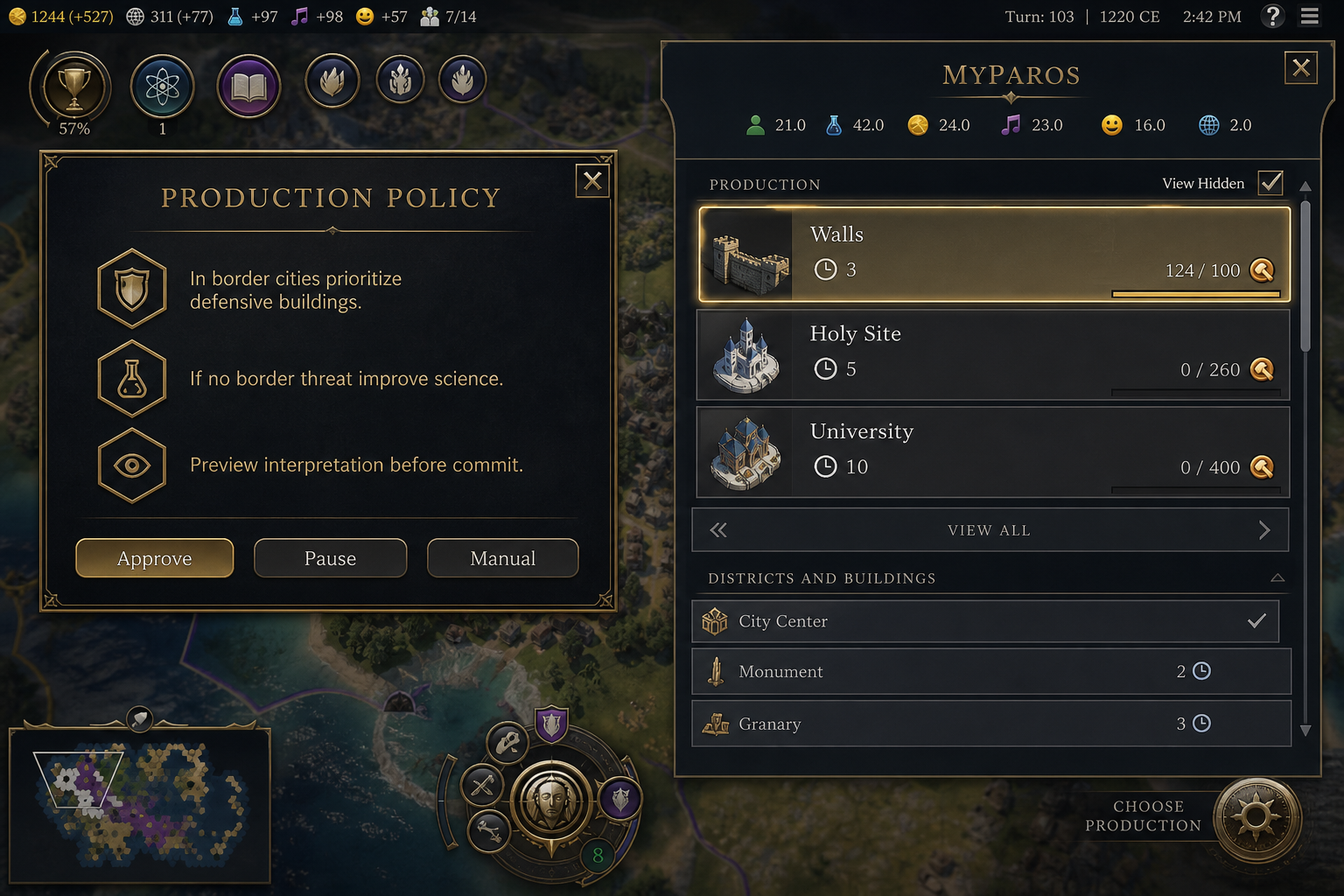
City production is a natural place to explore this distinction.
Production already has a clear legal action set. Each city has a known list of buildings, units, projects, and other valid choices. Language can select from that list without inventing actions, bypassing prerequisites, or changing the economic rules.
A player might write:
In border cities, prioritize defensive buildings. If a city has no current border threat, improve science instead.
Before applying the instruction, the game could show a structured interpretation:
- Which cities count as border cities.
- Which conditions count as a threat.
- Which defensive options are currently legal.
- Which science options are preferred.
- When the policy will be checked again.
- What happens when no valid option exists.
The player could approve the policy, apply it to selected cities, pause it, edit it, or remove it. Any city could return to direct control immediately.
Several constraints keep this surface legible.
Delegation is opt-in
No city receives a policy unless the player assigns one.
Policies use existing production options
The system chooses only from items the city could already produce. It does not grant bonuses, skip prerequisites, or create resources.
Interpretations are visible
The player can inspect the operational meaning before committing. Terms such as “safe,” “soon,” or “important” need definitions, previews, or clarification.
Manual authority remains available
A direct player order takes priority. The interface should explain whether that override is temporary or removes the city from the policy.
Policies are reversible
The player can revoke a policy without losing access to the normal production interface.
These limits do not make the production decision easier. They make the translation from language to game action inspectable and correctable.
Production policies can create new decisions
A single production command expresses a decision that already exists. A persistent production policy can create a different kind of decision.
Consider this policy:
Keep one military production city in each border region. Other cities should build economic infrastructure unless war is likely within ten turns.
The important work is not merely parsing the sentence. The policy needs an explicit relationship with uncertainty, resources, and player judgment.
What makes war likely? Does the policy use only information available to the player? Which city becomes the military center? Can it interrupt a wonder? How much production loss is acceptable when switching? Does it request approval before making an expensive change?
These questions can become strategic settings rather than hidden implementation details.
A production governor might have a limited planning horizon. It might be conservative about changing queues. The player might need to rank growth, defense, science, culture, and military readiness. A governor with greater authority might handle more conditions, but that authority could carry a higher cost or create a larger vulnerability.
The player still needs to understand the empire. The new challenge is to define a policy, assign its scope, accept its tradeoffs, and recognize when current conditions have exceeded its assumptions.
Governors can make delegation part of the empire
Once policies persist, governors become more than sources of statistical bonuses. They can carry and execute portfolios of player-authored intent.
For example:
Grow cities in this region until housing becomes a constraint. Then prioritize production. Maintain enough defense to survive a short surprise attack, but do not build offensive units without asking.
This creates several possible mechanics:
- Governors have a limited number of policy clauses.
- Complex policies require more administrative capacity.
- Governors differ in how quickly they react or how well they handle exceptions.
- Distant cities receive policy updates more slowly.
- Reassigning a governor temporarily disrupts delegated plans.
- A governor escalates unusual situations instead of guessing.
- Rivals can sabotage a governor, corrupt a policy, delay execution, or reveal its priorities.
Delegation now has a cost and an opponent.
The player must decide where administrative investment is worthwhile and where direct control remains more effective. A rival who learns that a frontier governor always prioritizes walls under a certain condition might manipulate that condition. The result could be wasted production or an opening elsewhere.
A policy that affects the game should be legible enough to contest. Its value comes from the decisions around authority, scope, and risk, not from silently producing expert play.
Commanders can carry multi-turn tactical intent
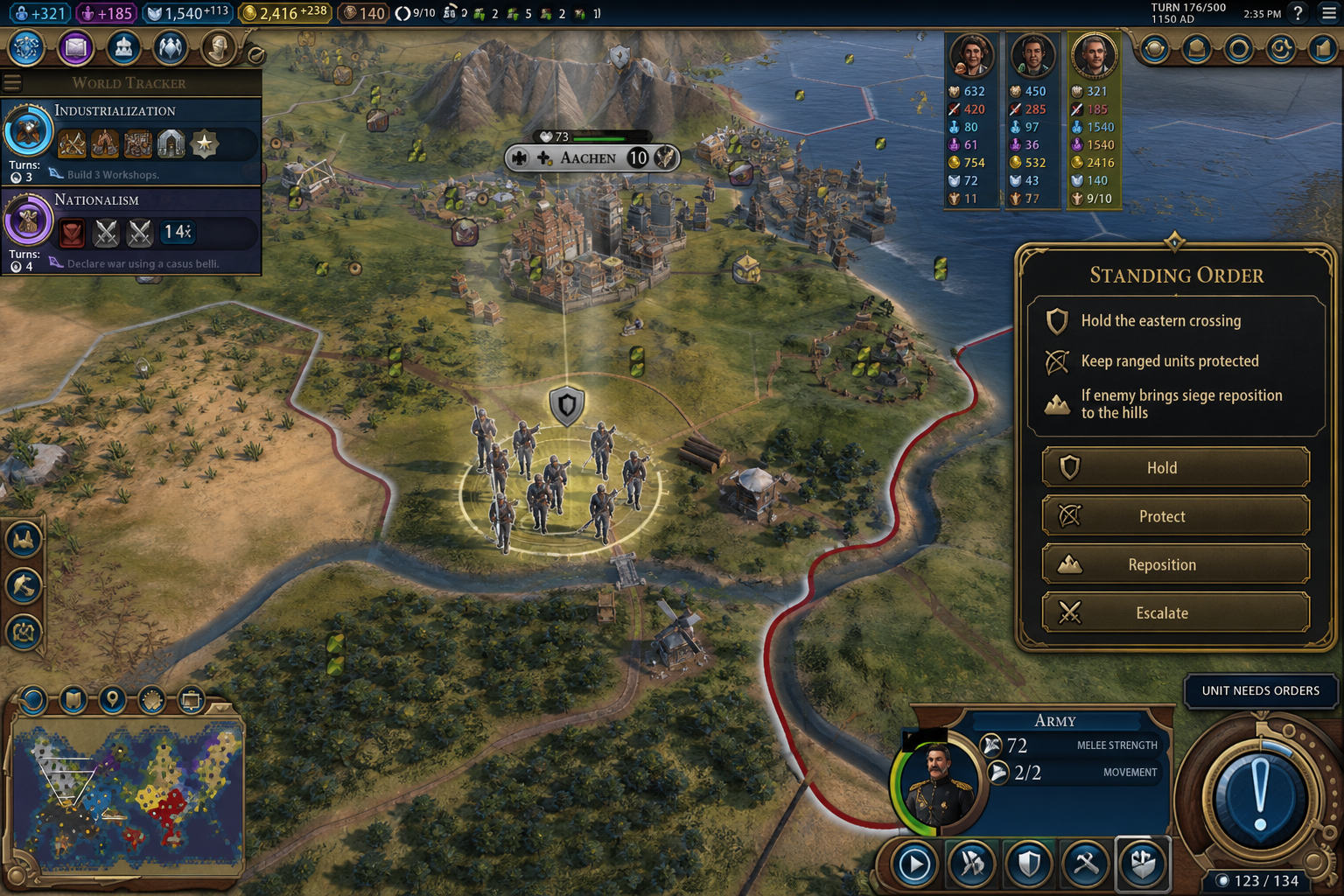
The same principle can apply to military control.
A direct command such as “move these units to the river” opens an existing control path. The player still chooses the destination and accepts the tactical consequences.
A commander becomes more interesting when it can hold a multi-turn standing order:
Hold the eastern crossing. Keep ranged units protected. If the enemy brings siege support, reposition to the hills and wait for reinforcements.
Where the unit rules support it, an order could also cover formation changes, fortification, escort behavior, packing and unpacking, or conditional withdrawal.
The commander should not produce a better tactical answer than a skilled player with perfect consistency. It should act within explicit limits:
- It uses only information available to its side.
- It controls only assigned units.
- It follows a bounded interpretation of the standing order.
- It has limited authority to spend movement, charges, or strategic resources.
- It escalates decisions outside its mandate.
- It can make predictable mistakes.
- The player can override any order.
The commander can also become a target. If it is captured or killed, the formation might lose its standing orders, suffer delayed coordination, or revert to simple default behavior.
This creates new tactical objectives. Protecting command capacity matters. Raids against leadership matter. A player can disrupt an opponent's ability to coordinate several fronts without receiving a direct combat bonus.
The tactical game remains difficult. The player now also decides how much intent to encode, which units to delegate, and whether the command structure is worth defending.
Diplomatic policies can manage recurring decisions
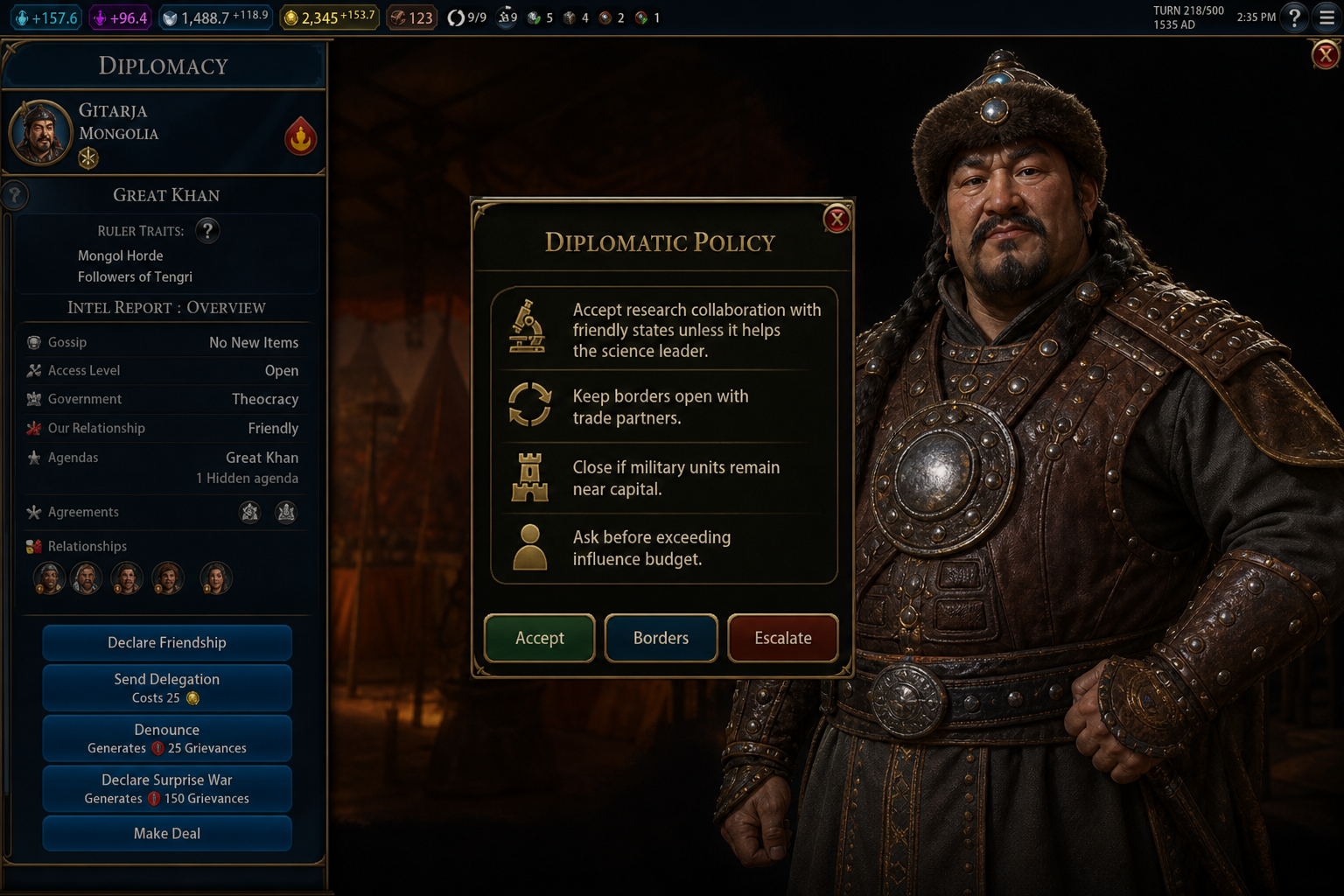
Diplomacy is another natural surface for persistent intent because recurring proposals often share strategic logic.
A player might establish rules such as:
Accept research collaboration with friendly states unless it helps the current science leader.
Keep borders open with trade partners. Close them if their military units remain near our capital.
Spend influence to prevent sanctions against us, but ask before exceeding this turn's budget.
These policies can handle familiar cases while preserving meaningful exceptions. The difficult judgment remains in the rule itself, its limits, and the situations that fall outside it.
The game should explain why a proposal was accepted, rejected, or escalated. Other diplomatic actors could learn or infer standing policies. A rival might submit proposals that test the limits of an influence budget. Another might conceal the true beneficiary of a research agreement. A public commitment could improve trust while reducing flexibility.
What becomes interesting is not automatic diplomacy. It is programmable statecraft with visible consequences.
Delegation should have a price
If persistent intent is free, perfect, and unlimited, it becomes a dominant convenience feature. Players will delegate every task the system handles competently, and the mechanic will remove decisions without adding new ones.
Costed delegation creates strategy.
Possible costs include:
- A limited number of governors or commanders.
- Administrative capacity for policy complexity.
- Influence costs for diplomatic standing orders.
- Delays when changing a policy.
- Reduced precision when one leader controls too many cities or units.
- Political risk when delegated agents fail or pursue their own priorities.
- Opportunity costs for protecting governors and commanders.
These costs should attach to delegated authority, not to language itself. A direct language command that selects a legal action does not need an artificial penalty. A persistent policy that acts across turns can carry costs because it provides continuing reach and coordination.
A skilled player might retain direct control of a decisive front while delegating stable interior cities. Another might invest heavily in administration, accepting fewer direct advantages in exchange for a larger coordinated empire. Both approaches can remain viable because each allocates strategic resources differently.
Counterplay keeps persistent intent active
Persistent policies become more interesting when opponents can observe, infer, and challenge them.
Counterplay could include:
- Reconnaissance that reveals broad policy priorities.
- Espionage that exposes specific conditions or thresholds.
- Sabotage that delays a governor's next policy update.
- Diplomatic feints that trigger an expensive standing response.
- Raids that isolate a region from its commander.
- Assassination or capture that removes delegated authority.
- False pressure on one border that manipulates production elsewhere.
Delegation then creates an attack surface.
A player who delegates effectively gains reach and coordination. A player who delegates predictably creates vulnerabilities. The strategic task is not to discover one perfect instruction. It is to design policies that remain useful under pressure, protect the systems that execute them, and intervene when conditions change.
An opponent also gains meaningful choices. They can attack units and cities, or they can attack the decision structure connecting them.
The game should stay hard
Intent-based control should preserve the demands that make Civilization satisfying.
The player still needs to understand geography, timing, production, diplomacy, military risk, and long-term opportunity. Language does not supply those judgments. It lets the player express them through the same rules that govern every other action.
The useful quality bar is not that the system plays as well as an expert. That would shift the source of competence away from the player.
A stronger target has clear properties:
- The system faithfully follows bounded intent.
- Its interpretation is visible.
- Its authority is limited.
- Its actions are legal and reversible.
- Its failures are understandable.
- Its use creates costs and vulnerabilities.
- Direct player control remains the highest-precision option.
Under those conditions, language opens the control surface without lowering the strategic bar.
Persistent intent then expands the player's responsibilities rather than removing them. The player can design production doctrine, assign military missions, establish diplomatic policy, allocate authority, protect command structures, and manage exceptions.
Each of those actions creates a decision that opponents can understand and contest.
From commands to a new strategy space
City production offers a clear surface for exploring language control because its actions are constrained, previewable, and reversible. It makes the core problem visible: translating player intent into legal game actions without changing the rules or choosing the strategy.
That alone can open Civilization's control surface to more players and more forms of expression.
The larger opportunity begins when intent persists. Governors and commanders can carry policies across turns. Delegation can consume administrative capacity. Standing orders can expose assumptions. Rivals can interfere with the people and systems that execute them. Manual intervention can remain decisive.
The goal is not to place a language form on top of Civilization or to automate away the work of running an empire.
The opportunity we see is a Civilization where intent becomes something the player can author, allocate, protect, revise, and oppose. The game stays hard, and the strategy space grows.