
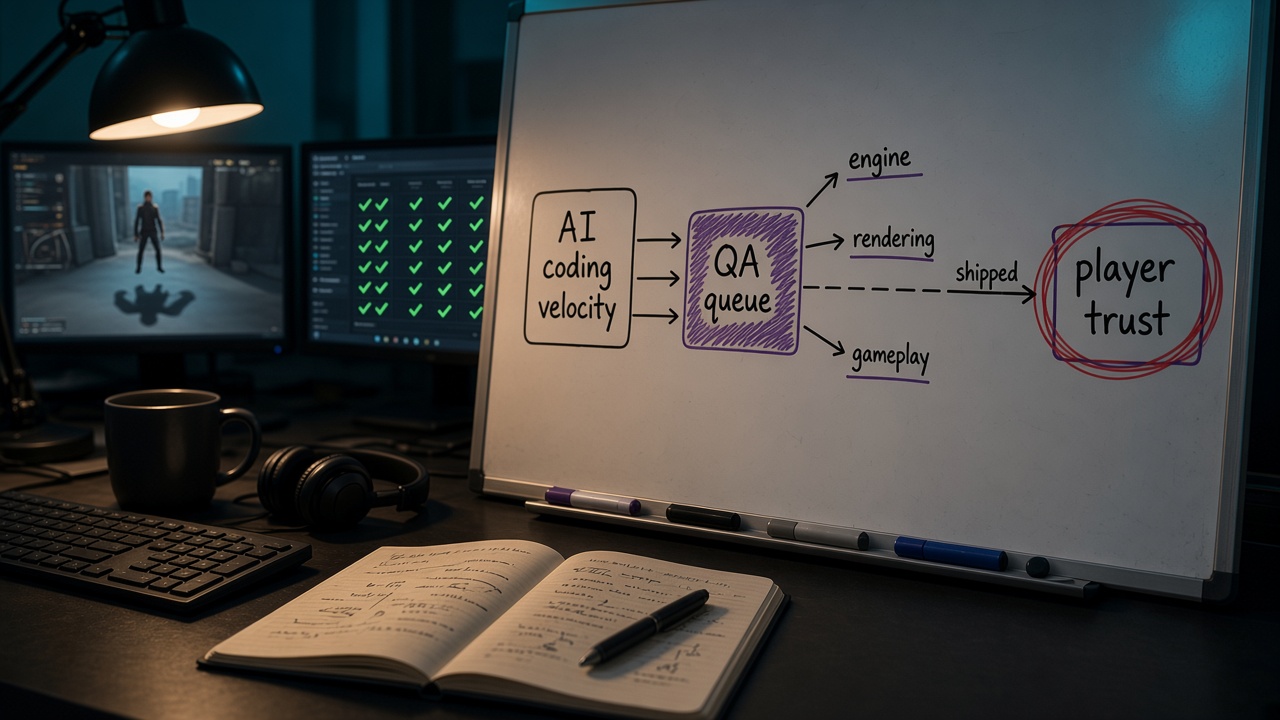
AI coding is creating engine, rendering and gameplay bugs faster than your QA team can find them
AI coding is creating engine, rendering and gameplay defects faster than legacy QA can find them. Playthrough provides an agentic QA path inside continuous development.
Your engineering leads are reporting velocity gains from AI coding and automated refactoring that were not possible a few years ago. More code is being written, changed, and shipped in less time. From the executive view, that can look like a clear productivity win. That confidence is dangerous if your QA capacity has not changed with it.
A game is not basic business software. A code change can move through the engine, rendering systems, gameplay logic, UI and platform-specific behavior. AI can produce a valid-looking change while introducing defects across several parts of that stack. Those defects become a new form of technical debt before your QA team has enough time to understand what changed.
Your engineering throughput may be rising while your ability to verify the build remains fixed. If your current QA workflow depends on manual playthroughs, scripted test paths and late-stage visual review, it will not keep pace. You are producing risk faster than your team can inspect it.
A live-ops studio increased code velocity and created rendering defects
A major live-ops studio adopted automated refactoring and AI coding to make its game run more efficiently. The engineering objective was reasonable. The studio wanted to improve performance without assigning people to every repetitive code change.
The result included rendering defects that the team could not identify or fix quickly.
This is the gap executives need to examine. AI can change more code than a human team could change in the same period, but the resulting build still has to be observed in motion. A rendering defect may only appear under a particular camera position, scene state, animation, effect or hardware condition. A code review can look correct while the rendered result is wrong.
The studio gained development velocity, then gave part of that gain back through investigation and repair. Its QA process had not been designed for the number and variety of changes entering the build. Increasing code production without increasing verification capacity creates that exact trap.
A remaster failure showed how weak QA ownership destroys trust
A large studio outsourced the remastered edition of a beloved classic that was approximately 15 years old. It worked with a co-development partner and used AI shortcuts in the production process.
Players found AI-upscaled unit art with extra fingers and melted faces. Those images became the visible symbols of the failure, but returning bugs caused deeper damage. Problems that modders had fixed over more than a decade came back in the remastered edition.
The game's Steam score fell from about 91% positive to under 20%. The complete edition was pulled from the store, and the original version was put back on sale. There was no AI disclosure on the store page despite the platform's rules. The studio later apologized and blamed a "development partner," without naming AI as the root cause.
The visual mistakes attracted the headlines. The return of long-fixed bugs showed the more serious QA problem. The release appeared to move forward without clear ownership of regression coverage, historical defect knowledge, and final build verification. A remaster carries an unusual quality burden because players already know how the original behaves, and modders may have documented and fixed issues for years.
AI shortcuts can reduce production effort, but they also increase the need for structured review. Outsourcing does not remove that responsibility. If neither the studio nor the co-development team owns full regression coverage, defects can cross the release boundary while each group assumes the other has checked them. In this case, weak QA ownership and AI shortcuts damaged reviews and player trust.
Studios are giving AI development gains back through legacy QA
In our conversations with studios, the pattern is already visible. Teams are gaining speed on the software development side, then giving much of that time back through legacy QA processes.
Builds are changing faster. QA teams still have limited hours, limited device access and a fixed number of people who can play through each release candidate. They must choose which paths to test and which areas to leave for later.
Some studios are trying to add AI to QA. Many of those implementations remain surface-level. They may summarize a test, generate a script or produce a reasoning chain that suggests the system understands the game.
Studios sometimes celebrate those weak signals because they show a modicum of results. A plausible reasoning trace is not proof that the system can play the build, recognize a defect, reproduce it and produce evidence that an engineer can use.
The standard should be operational. Can the system enter the real build through its UI? Can it respond to changing game states without depending entirely on scripted paths? Can it identify functional and visual problems? Can it provide captured evidence and reproduction steps? Can it run whenever a new build enters the continuous integration pipeline?
Until it can do those things in the pipeline, AI in QA has not removed the bottleneck that is taking back your development gains.
Agentic QA needs to operate inside continuous development
The answer shape is agentic QA inside continuous development and CI.
The agent needs to play the actual build, observe what happens and report suspected defects in a form your team can review. A new build should be able to trigger that process without waiting for a manual test cycle to begin.
Existing vendors only cover slices of that job, and the gaps show up as soon as build velocity rises.
Nunu.ai and ManaMind watch the screen with a single-model agent. That can catch some visual issues, but the coverage stays narrow, and a single observer still invents defects and misses others. Modl.ai and Regression automate play through the engine. They help with state, rules and learning-based paths, and they still leave rendered bugs and deeper triage on your people. Keywords Studios can add QA analysts, lab capacity and managed testing. That scales headcount. It does not make the build verify itself in CI, so every velocity gain still buys you a larger bench.
None of these approaches puts deep agentic visual and functional coverage inside continuous development. Your team still absorbs the gap.
Human QA remains necessary. The goal is to stop asking people to spend most of their time repeating basic build checks that software can perform. Your QA bench should have more time for complex investigation, player experience, edge cases and areas where human judgment remains stronger.
ReBlink's Playthrough platform combines autonomous play with visual defect review
ReBlink's Playthrough agentic QA platform (Playthrough) puts autonomous play and visual defect review inside your continuous development and CI pipeline. Playthrough Bots play the real build while a separate review path checks what the player sees, across functional, logic, flow, UX, and visual issues. Multi-step verification means findings do not rest on one model alone. Each ticket arrives in plain language, with supporting frames and reproduction steps your production and QA leads can act on.
Playthrough supports CI-triggered runs and a video-only path that requires no SDK, with optional engine and state hooks for deeper context. An optional in-build package can expose live game state.
Coverage extends beyond conventional playthroughs. Playthrough can run economy, win-rate, and stat-balance simulations, apply random high-speed input testing, and check translated text displayed on screen. It supports Windows and macOS locally and on AWS, with iOS, Android, Xbox, and PS5 testing through desktop simulators. The console and VR path includes PS5, Xbox, Switch, and Meta Quest. Android and iOS device farms are on the roadmap, with partnerships and integrations with testing solutions to be announced.
On high-context deployments, our strongest benchmark results reach 88% recall on real defects, 98% precision on flagged frames, and false alarms as low as 1.1% on mobile UI screens. That breadth and depth finds what human QA cannot scale to catch at AI-coding velocity, and frees the QA bench for deeper, more valuable work.
Cold-start testing shows the baseline without integration
Even at cold start, with no source code, setup, or game context, Playthrough overperforms relative to shallow single-model or script-only approaches. It can augment existing QA workflows immediately, while code diffs, state and engine hooks, and CI integration unlock deeper testing.
Save 75%+ of QA hours, or put that capacity into higher-value work
This figure comes from a case study on the title Arena Tactics. After Playthrough was added, that team spent far fewer hours on repeat smoke, functional, and visual passes, which freed capacity for higher-value QA work. The comparison covers time spent on per-build smoke and functional playthroughs, plus visual checks, before and after Playthrough. It measures time spent on those passes, not the share of bugs found. It does not include device compatibility testing, which was not automated in that deployment.
The remaining hours went to reviewing the agents' tickets and to manual passes on areas the agents did not cover reliably yet. The high end of the range assumes a fully integrated deployment: code diffs, state and engine hooks, deterministic and agentic headless QA and balancing, and automated visual workflows. We encourage pilots for studios to measure against your QA hours and identify the potential opportunities for your team.
What changes for your QA bench
Playthrough finds issues that human QA cannot scale to catch at the velocity AI coding creates. It does not replace your QA team. Agents take the repeat smoke, functional, and visual passes across builds, so your analysts can go deeper into difficult reproduction paths, player experience, unusual interactions, and defects that need judgment or platform-specific knowledge.
Faster code production needs continuous verification in the pipeline. Without that, the engineering gain turns into a growing queue of undetected engine, rendering, and gameplay risk. Do not miss the chance to ship well-built games, and do not put your studio's reputation on the line with false confidence that velocity alone means quality is holding.
Schedule an audit of your QA workflow
If AI coding is raising how much your team changes each week and QA is where the risk now waits, schedule an audit of your QA workflow with our team. Bring your current build cadence and how your team triages issues today. We will show you where agentic QA in CI would take load off your testers, free the bench for higher-value work, and replace false confidence with verified builds.